

Read Reviews
The Best Stud Finders
-
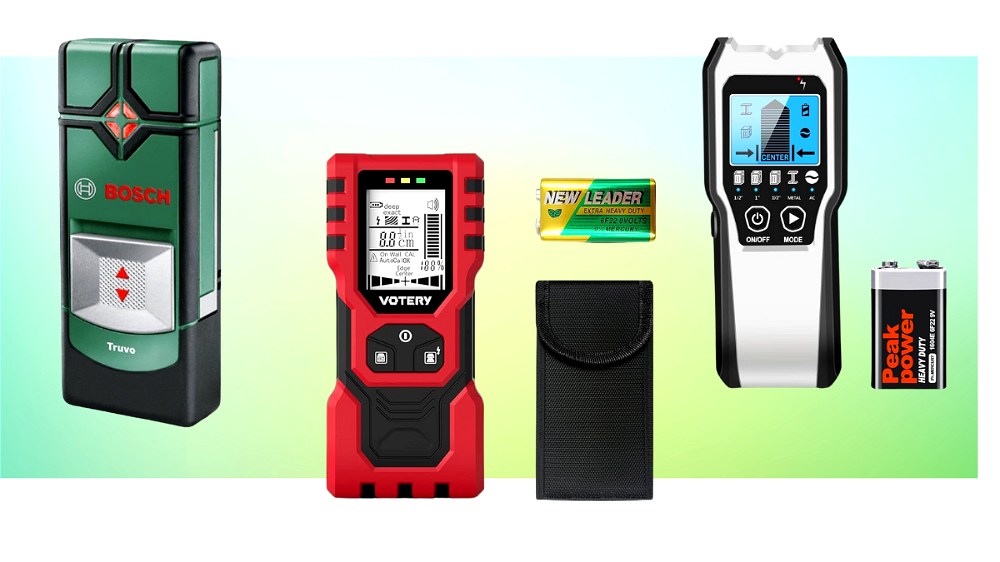
Best stud finder for quality and price - Bosch Truvo Digital Wall Detector
-
Best for depth of scan (metals) - Bosch Professional Metal Detector GMS 120
-
Best for large screen - Folai Multifunction Wall Scanner
-
Best stud finder for ergonomic design - Tavool 5 in 1 Stud Finder and Wall Scanner
-
Best 5 in 1 wall scanner - Huepar 5 in 1 Stud Finder Wall Scanner
-
Best for depth of scan (ferrous and non-ferrous metals) - Votery Stud Finder 5 in 1 Scanner with Case
-
Best budget alternative - UltraTool LCD Stud Detector
-
Best budget stud finder - Merece 5 in 1 Stud Finder Wall Scanner
Stud Finder Reviews
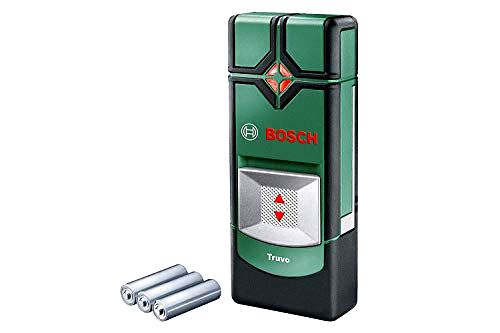
1. Bosch Truvo Digital Wall Detector[ SAVE 38% ]
Best stud finder for quality and price
- A simple and straightforward stud finder. Compared with the Tavool TH510, there’s less buttons and settings to fiddle with.
- It’s not that often you get a battery powered tool with batteries included.
- This stud finder is sensitive. I’d rather use one that was slightly over sensitive than anything else. You can’t be too safe when it comes to electrics.
- The simple lighting system makes short work of finding stuff behind the walls. Yellow when something’s close and red when you’re on top of metal. Almost too easy to understand.
- Auto calibration saves you when, like me, you forget to calibrate the device each time.
- This stud finder doesn’t locate studs. It’s designed to find metals. There’s no timber detection mode for wood studs but you can still detect metal screws in studs.
- It can’t scan as deeply as the Bosch GMS 120. But it’s a lot cheaper!
- Some users have found the device to be temperamental. Make sure you read the manual carefully before use.
- Like many stud finders, your clothing and even footwear can have an effect on readings.
- Detection Modes
- 3
- Non-Ferrous Scan
- 60mm
- Ferrous Scan
- 70mm
- AC Current Scan
- 50mm
- Timber Scan
- n/a
- LED Indicator
- 3 colours
- Auto Calibration
- Yes
- Batteries Supplied
- 3 x 1.5V
- Build Quality
- 4
- Performance
- 4
- Ease of Use
- 5
- Value for Money
- 4
The Bosch Truvo is probably the best stud finder because it’s simple, reliable and easy to use. And it’s made by German tool champs Bosch. The Truvo uses a series of LEDs and different audio tones to tell you when you’re close to metals and live electrics. Specifically, steel at 70 mm, copper at 60 mm and live cables at 50 mm.
It’s a ridiculously easy-to-use bit of kit. One button to operate and a vivid set of lights that ping on when you hover above metal objects. There’re even directional bars that help guide you to the exact location of the ferrous or non-ferrous metal hiding below the surface.
As someone who often forgets to switch off tools, I was pleased to see an auto-turn off feature. It’s something you’d expect from the best stud finder on the market. The three included AAA batteries offer a useful five hours of continuous use as well. I’m happy to say it’s ready to work straight from the box.
Did you find this review helpful?
2. Bosch Professional Metal Detector GMS 120
Best for depth of scan (metals)
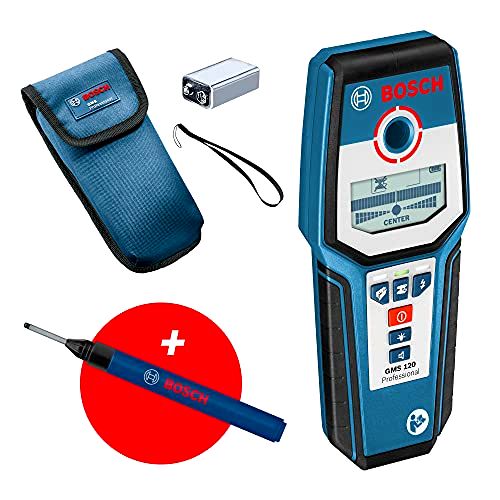
- I like the wrist strap that comes with this stud finder, it’s a bit of extra safety should you drop it during use.
- This is a decent stud finder, as simple as it can be to use. Select the mode and start scanning.
- The IP54 protection rating is essential if you forget to wear the wrist strap!
- The viewfinder hole assembly is made from metal. It gives the device a professional feel.
- Some users have found that the blue casing on the stud finder can mark white walls.
- Compared to other stud finders this is expensive. Unless you’re using it all the time, you could save a lot of money on the cheaper Bosch Truvo.
- Bosch recommend you take off any jewellery, gloves and sometimes even shoes. It’s a lot to do to find a simple piece of metal.
- Detection Modes
- 3
- Non-Ferrous Scan
- 80mm
- Ferrous Scan
- 120mm
- AC Current Scan
- 50mm
- Timber Scan
- 38mm
- LED Indicator
- 3 colours
- Auto Calibration
- Yes
- Batteries Supplied
- 1 x 9V
- Build Quality
- 4
- Performance
- 4
- Ease of Use
- 5
- Value for Money
- 3
Coming from Bosch’s “blue” range of professional tools, the GMS 120 is a serious bit of kit. It auto-calibrates, has a large readout display, and features bright LED lights as well.
Compared to the Bosch Truvo detector, this stud finder finds items buried much deeper. It’s good for finding ferrous metals at up to 120 mm depth, and non-ferrous at 80 mm. You can also scan for live AC current at up to 50 mm depth.
The LED light makes this one of the best stud finders for professionals because it centres around a hole in the device. This means you can pinpoint the spot you want to drill and then use a pencil or other marker to push through it and make your mark.
If the electronic stud finder moves across metal, it lights up red. And if it detects live wire, it flashes red to give you a suitable warning. It’s a great electronic stud finder because even though it’s capable and accurate, you only need to press one button for results.
Did you find this review helpful?
3. Folai Multifunction Wall Scanner[ SAVE 3% ]
Best for large screen
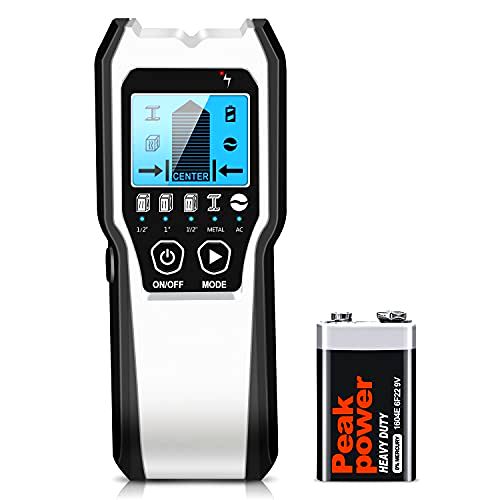
- You can search for metals, including metal pipes, timber, and electrical wire.
- The small “v” shaped groove in the top of the stud finder keeps your pencil centred.
- This stud finder is easy to use. You only need to press two buttons to get going.
- The large visual “centre” display works well and couldn’t be easier to read.
- Like some other stud finders calibrating the device before each use is a pain.
- For an accurate reading you need to make several scans of the target area to find studs.
- An auto turnoff function is essential for stud finders if you ask me. It’s a disaster waiting to happen when your batteries run out.
- Detection Modes
- 5
- Non-Ferrous Scan
- 60mm
- Ferrous Scan
- n/a
- AC Current Scan
- 51mm
- Timber Scan
- 12, 25, 38mm
- LED Indicator
- 1 colour
- Auto Calibration
- No
- Batteries Supplied
- 1 x 9V
- Build Quality
- 4
- Performance
- 3
- Ease of Use
- 4
- Value for Money
- 4
If you want a 5 in 1 wall scanner without breaking the bank, the Folai wall stud finder is one of the best electronic stud finders for the money. Even though it needs calibrating for every use, I think it’s easy to operate and accurate as well.
The large screen shows you everything you need to know to find studs – when you’re close to a stud the display comes to life with a handy arrow that points to where the middle of it is. And when you’re dead on, the stud finder plays a tone and tells you “Centre”. Simple.
The three depths for timber stud scanning are 12, 28 and 38 mm, it can read AC current at 51 mm depth and deep scan for metals up to 60 mm deep. That means it’s up there with some of the best stud finders in terms of wall penetration.
Did you find this review helpful?
4. Tavool 5 in 1 Stud Finder and Wall Scanner
Best stud finder for ergonomic design
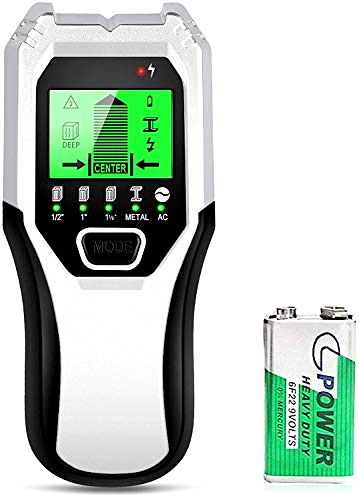
- This is an extremely lightweight and portable electronic stud finder at just 260g. You won’t get tired holding this against a wall!
- The back of the device has a soft texture to avoid scratching walls.
- The screen is bright and easy to read. I like the “centre” feature. It takes a lot of guesswork out of finding the right place to drill.
- Compared to the Bosch Truvo or GMS 120 stud finders, it’s an absolute bargain.
- Even when you’re not in live AC detector mode, it will still show when you’re close to a current.
- Like some other stud finders on my list, this detector needs to be calibrated before each use.
- The build quality isn’t great compared to the Bosch Truvo. It won’t last anywhere near as long as some other stud finders.
- Some users have found the stud finder only gives accurate results in deep scan mode.
- Some users have had issues with the live AC detection. It can be too sensitive at times.
- Detection Modes
- 5
- Non-Ferrous Scan
- 60mm
- Ferrous Scan
- n/a
- AC Current Scan
- 51mm
- Timber Scan
- 12, 25, 38mm
- LED Indicator
- 1 colour
- Auto Calibration
- No
- Batteries Supplied
- 1 x 9V
- Build Quality
- 3
- Performance
- 3
- Ease of Use
- 3
- Value for Money
- 4
With an impressive range of measurement and inspection devices and other handy tools, Tavool know a thing or two about making the best stud finder for the UK market. Their TH510 sensor wall scanner features five scan modes. It really can detect anything that lurks behind your walls.
I was impressed with the ergonomic design, it’s easy to hold and looks like something out of a sci-fi film. The white body alongside the green backlit screen looks good and it’s thankfully easy to use. You just press a single button to operate all the modes.
The three stud scan modes work at depths of 12 – 25 mm. The Deep Scan mode is a particularly useful feature. You can use it to look through two layers of dense plasterboard up to 38 mm thick. It’ll pick up metals at 60 mm and live current at 12 mm.
Did you find this review helpful?
5. Huepar 5 in 1 Stud Finder Wall Scanner
Best 5 in 1 wall scanner
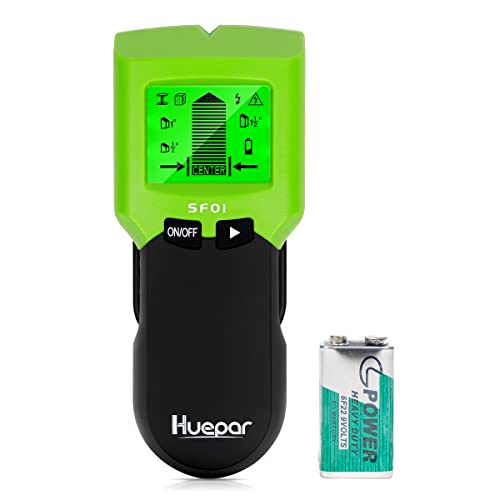
- Having five different scanning modes gives you an obvious advantage compared with the Bosch’s three modes. Being able to change the depth of scan on the fly is great.
- I really like the live AC detector function. It runs in the background of any detecting mode, because whether you’re looking for live cables or not, you don’t want to hit one.
- The buzzer feature is handy for telling you, without looking, that you’re on a stud or have hit metal. When you’re detecting above your head, you can’t always look at a screen.
- Some users have complained that the detector feels a bit light, and not exactly premium. Although it’s nowhere near as tough as the excellent Bosch Truvo, it’s half the price.
- This detector lacks an auto-calibration feature. If you forget to calibrate the device each time you use it, it can be quite inaccurate. It only takes a few seconds, but it’s a bit of a pain.
- Compared with the Votery stud finder, this device can’t tell the difference between ferrous and non-ferrous metals. Depending on the work you’re going to do, this could be important.
- Detection Modes
- 5
- Non-Ferrous Scan
- 60mm
- Ferrous Scan
- n/a
- AC Current Scan
- 51mm
- Timber Scan
- 12, 25, 38mm
- LED Indicator
- 1 colour
- Auto Calibration
- No
- Batteries Supplied
- 1 x 9V
- Build Quality
- 4
- Performance
- 4
- Ease of Use
- 4
- Value for Money
- 4
The clever people at Huepar make a decent range of measuring devices, from green laser levels to this excellent SF01 5-in-1 stud finder wall scanner. It’s easy to use and comes with plenty of different modes to detect studs at different depths, metal, and AC current electricity.
This small green device is lightweight and small enough to fit in a tool bag, comes with a bright green LCD backlit screen, and is easy to use thanks to just two buttons to press. You can scan for studs at three different depths- 12, 25, and 38 mm, detect metal up to 60 mm deep, and there is also the all-important AC electric cable scanner.
There’s a small “V” groove cut out of the top of the scanner that lines up with the sensor. It means you can make a pencil mark in line with the stud accurately. The closer you get to a stud or cable, the larger the arrow symbol grows until it gives you a visual and audio indicator that you’re on the centre. And they’ve even thrown in the required 9V battery to get you going.
Did you find this review helpful?
6. Votery Stud Finder 5 in 1 Scanner with Case
Best for depth of scan (ferrous and non-ferrous metals)
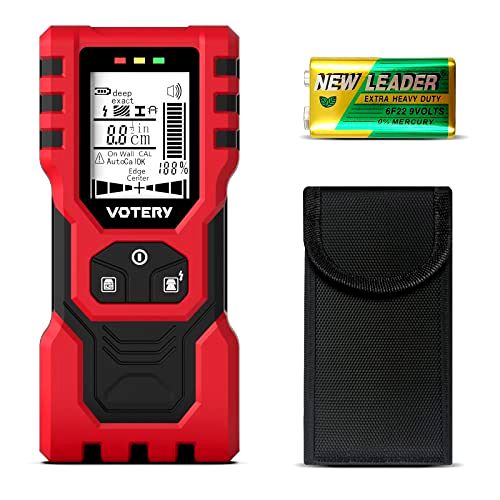
- These sorts of devices are usually chucked in a toolbox, which isn’t always the safest place for them. Having a protective case included in the price should help avoid accidents.
- For the price, it’s impressive that this scanner gives you accurate distance information on the screen. The distance to the stud, metal, or live AC cable is shown clearly in centimetres.
- Being able to scan up to 120 mm deep for metal is an impressive feat for an inexpensive wall scanner. If you’re looking for a steel lintel or buried copper pipes, this is a great bit of kit.
- If it’s possible to have too much information on the screen, Votery have done it. If you want a simple and straightforward stud finder, this one has a few too many bells and whistles.
- Like the Huepar scanner, this scanner does not auto-calibrate. It’s vital that you scan the wall before looking for metal or live AC. It takes just a couple of seconds, but I’d still forget!
- An auto-off function would be welcome to avoid running the batteries flat.
- Detection Modes
- 5
- Non-Ferrous Scan
- 100mm
- Ferrous Scan
- 120mm
- AC Current Scan
- 50mm
- Timber Scan
- 20, 38mm
- LED Indicator
- 3 colours
- Auto Calibration
- No
- Batteries Supplied
- 1 x 9V
- Build Quality
- 4
- Performance
- 4
- Ease of Use
- 4
- Value for Money
- 4
Stud finder specialists Votery don’t seem to make anything else, so it’s a good thing that they’ve made one of the best metal finding scanners I’ve come across so far. The 5 in 1 scanner they’ve come up with is a brilliant piece of kit for the money thanks to some clever features. It can scan for non-ferrous metals much deeper than even the professional brands on my list.
The bright backlit screen houses plenty of information that you can make use of when detecting for studs, metal, or AC current. The bar on the right side is a visual indicator of distance from the target, but you also get the same reading in centimetres for greater accuracy. Not only do you get a bright readout, but a three LED “traffic light” indicator as well as an audio buzz to tell you when you’re on the centre.
You can scan for studs at two different depths that correspond to typical sheet materials- 20 and 38 mm. But where this bit of kit is brilliant is detecting for metal – you can penetrate the wall up to an impressive 100 mm for non-ferrous and 120 mm for ferrous metals. Scanning for live AC current is also possible on this clever piece of equipment.
Did you find this review helpful?
7. UltraTool LCD Stud Detector
Best budget alternative
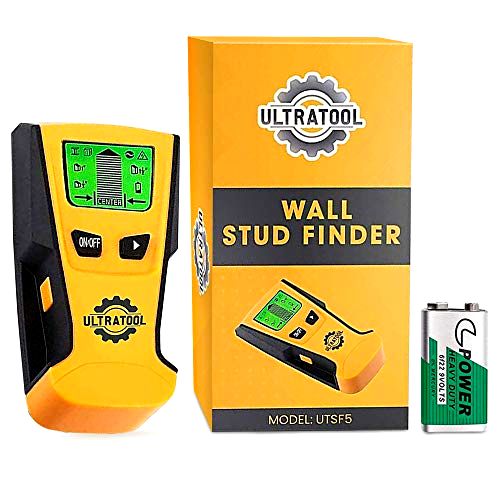
- Compared to the premium Bosch Truvo, this stud finder is an absolute bargain!
- Use it to find different depths of timber studwork, metals and AC current behind the walls.
- It would have been nice to get a 9V battery included.
- Not as simple to use compared with the Tavool TH510 or some other stud finders. You need to hold the side button as you scan.
- Some users have complained about the build quality. It’s not the sort of thing you’d take on site with you.
- Showing everything in imperial measurements is a bit confusing to me.
- Detection Modes
- 5
- Non-Ferrous Scan
- 60mm
- Ferrous Scan
- n/a
- AC Current Scan
- 51mm
- Timber Scan
- 1/2", 1", 1-1/2"
- LED Indicator
- 1 colour
- Auto Calibration
- No
- Batteries Supplied
- Bare
- Build Quality
- 3
- Performance
- 3
- Ease of Use
- 3
- Value for Money
- 4
You need to find wall studs and you don’t want to hit live cables when you’re putting up a TV bracket. Luckily, the UltraTool stud detector is one of the best cable finders for the money. It’s not as accurate as some premium stud finders. But it’s better than tapping on a wall and listening for a hollow sound.
It’s also not quite as straightforward to use as some of the stud finders on our list. After carefully reading the manual, I got the hang of it though. There are two buttons on either side of the case, one for scanning metal and the other for studs.
It’s a useful bit of kit to have in the toolbox. For some reason, the detection depths are in imperial measurements – ½”, 1″ and 1½” stud depths. It works the same way as the competition. The arrows flash up and it beeps when you’re on the centre of a metal stud.
Did you find this review helpful?
8. Merece 5 in 1 Stud Finder Wall Scanner
Best budget stud finder
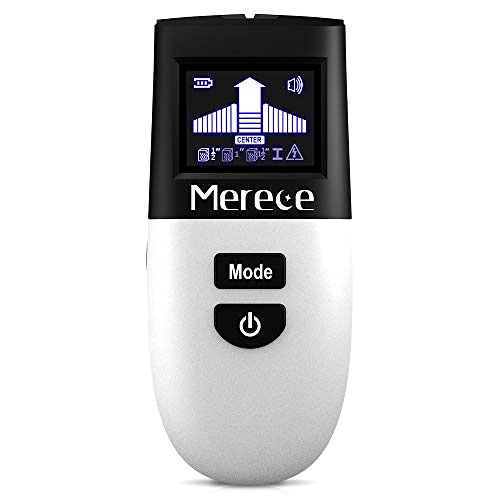
- A well-designed and simple stud finder that’s easy to operate.
- The scanning area is large and helps you pick up studwork and metals.
- The stud finder readout is backlit and crystal clear.
- This electronic stud finder struggles with pinpointing live wires. Make sure you scan the area several times before drilling.
- Make sure you read the instructions carefully. Lots of things can affect the reading, including Wi-Fi signal!
- It’s not the cheapest of the budget stud finders!
- Detection Modes
- 5
- Non-Ferrous Scan
- 60mm
- Ferrous Scan
- n/a
- AC Current Scan
- 51mm
- Timber Scan
- 12, 25, 38mm
- LED Indicator
- 1 colour
- Auto Calibration
- No
- Batteries Supplied
- 1 x 9V
- Build Quality
- 3
- Performance
- 3
- Ease of Use
- 3
- Value for Money
- 4
I was pleasantly surprised with this handy little 5 in 1 wall scanner from the people at Merece. Design-wise it’s clean and unfussy, with a sleek black and white colour scheme and matching LCD screen.
You can scan as deep as 12, 28 and 38 mm for timber stud work, search for metals and even find live wires. It’s ideal to have around the home for checking before you start drilling. Weighing in at 360g, there’s not much chance you’ll get tired of holding it up against the wall either.
I like the simplicity of the two-button operation. Turn it on with the power button and cycle through the settings with “mode”. It doesn’t get much easier than that! It’s great that these electronic stud finders auto-calibrate themselves before use as well.
I found the wall scanner to be reasonably accurate. It did well at finding metal studs and picked up metal pipes behind plaster walls but was a little bit tricky when it came to live wire detection. I always advise turning off the mains before doing any work anyway.
Did you find this review helpful?

Harry's Smart Buying Tips
Compare Product Features
Use the dropdown to sort the table by the feature you want to see.
Bosch Truvo Digital Wall Detector

- 4.3
- 3
- 60mm
- 70mm
- 50mm
- n/a
- 3 colours
- Yes
- 3 x 1.5V
Bosch Professional Metal Detector GMS 120

- 4
- 3
- 80mm
- 120mm
- 50mm
- 38mm
- 3 colours
- Yes
- 1 x 9V
Folai Multifunction Wall Scanner
- 3.8
- 5
- 60mm
- n/a
- 51mm
- 12, 25, 38mm
- 1 colour
- No
- 1 x 9V
Tavool 5 in 1 Stud Finder and Wall Scanner

- 3.3
- 5
- 60mm
- n/a
- 51mm
- 12, 25, 38mm
- 1 colour
- No
- 1 x 9V
Huepar 5 in 1 Stud Finder Wall Scanner
- 4
- 5
- 60mm
- n/a
- 51mm
- 12, 25, 38mm
- 1 colour
- No
- 1 x 9V
Votery Stud Finder 5 in 1 Scanner with Case
- 4
- 5
- 100mm
- 120mm
- 50mm
- 20, 38mm
- 3 colours
- No
- 1 x 9V
UltraTool LCD Stud Detector
- 3.3
- 5
- 60mm
- n/a
- 51mm
- 1/2", 1", 1-1/2"
- 1 colour
- No
- Bare
Merece 5 in 1 Stud Finder Wall Scanner
- 3.3
- 5
- 60mm
- n/a
- 51mm
- 12, 25, 38mm
- 1 colour
- No
- 1 x 9V
How to Choose The Best Stud Finder
Stop tapping the wall when you need to find something solid to drill into!
The Benefits of a Stud Finder
If you want to put up a TV bracket or a set of shelves, you’re going to have to drill some holes in your walls. The old way of finding where your wall studs are is by tapping across the surface until it stops sounding hollow. It’s not accurate and it won’t tell you where live electric cables are, which you’ll agree is pretty important.
A digital stud finder takes all the guesswork out of where to safely drill a hole. Simply turn it on and pass it across your wall to find out where, and where not, is a safe place to start making holes.
Features to Look Out For
The best stud finder makes it easy to find the timber supports behind your walls. If you want to put up shelves that can hold heavy weights or hang a TV that won’t fall down though, finding wood or metal studs isn’t enough. You need to find the exact middle to ensure a solid fixing, and the stud finder will do just that with an audio tone and on the display.
More basic stud finders will require calibrating between uses to deep scan your wall accurately. Even though it only requires a push of a button, this takes time and can cause problems if you forget to do it, so an auto-calibrating stud finder is a premium feature to look out for.
Stud Finder FAQs
A stud is the technical term for the piece of timber or metal that sits inside your wall and makes up part of the wall frame. Wooden or metal studs add strength to the wall and work as a place to attach the wall covering like plasterboard.
A stud finder is a small, handheld device that can be used to detect items that are hidden behind plaster or plasterboard or above ceilings or under floors. More advanced electronic stud finders, such as the ones in this review, have multiple modes that detect metal and wooden studs, live AC wiring, non-ferrous metal (such as copper pipe) and ferrous metal (such as steel reinforcement bars).
The best electronic stud finders can detect wood or metal studs to a depth of up to 38mm. The scanner can also detect live wires up to a depth of 50- 60 mm. The actual depth a stud finder scans varies between models, so check your user manual.
Operating a stud finder is pretty simple – you turn it on, select the mode for detecting studs, metal or electric current and pass it across the wall until it beeps. Different stud finders vary in their operation, but the principle is the same.
About Your Guide


Share